
How Many Words Per Page in a Book? Complete Facts & Insights
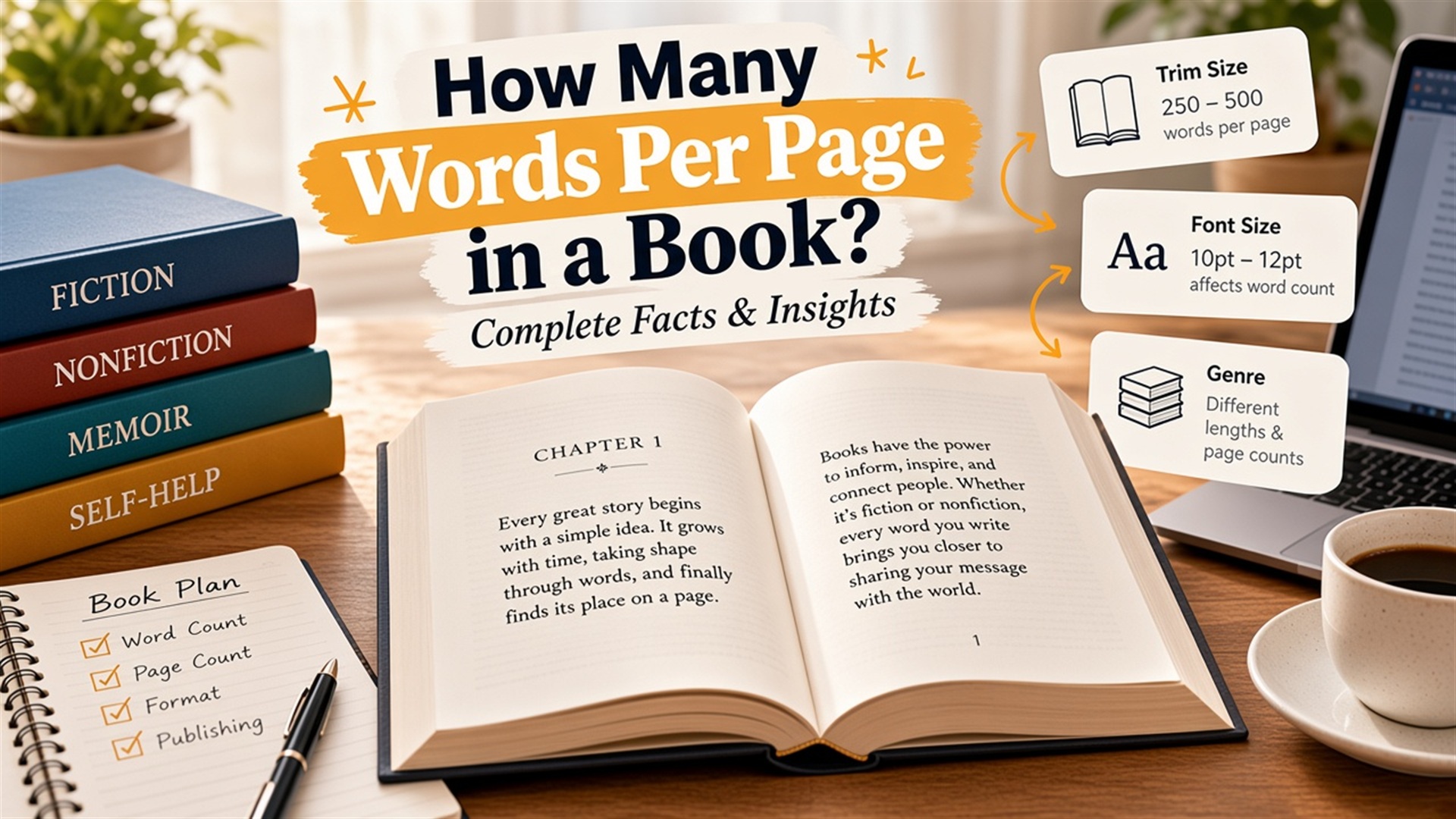
Here's a question that sounds simple until you actually try to answer it: how many words fit on a page in a book? Whether you're planning your first manuscript, estimating your page count before publishing, or trying to figure out if your 60,000-word draft will actually fill a full-length book, this question matters more than most authors realize. If you've been searching for ebook writing services or preparing a manuscript for publication, understanding word-per-page counts helps you plan smarter, price better, and present your work more professionally. This guide gives you the complete, honest breakdown.
Why Word-Per-Page Count Actually Matters
Most writers focus obsessively on total word count and ignore page count entirely until they're staring at a proof copy that looks nothing like what they imagined.
Here's why it matters:
- Pricing: Print-on-demand costs are calculated per page
- Reader perception: A 180-page book feels different from a 320-page book — even at the same word count
- Genre expectations: Readers in different categories have strong instincts about book length
- Formatting decisions: Font size, margins, and line spacing dramatically affect your final page count
- Ebook conversion: Digital formats reflow text differently than print — knowing your baseline matters
Understanding word-per-page counts is one of those unsexy but genuinely important parts of the publishing process that separates prepared authors from frustrated ones.
The Honest Answer: It Depends on These Factors
There is no single universal answer and anyone who gives you one flat number without context is oversimplifying. Here's what actually determines how many words fit on a page:
1. Trim Size (Book Dimensions)
The physical size of your book is the single biggest variable.
| Trim Size | Common Use | Approx. Words Per Page |
|---|---|---|
| 5" x 8" | Fiction, memoir | 250 – 300 words |
| 5.5" x 8.5" | General nonfiction | 270 – 320 words |
| 6" x 9" | Business, self-help | 300 – 350 words |
| 8.5" x 11" | Textbooks, workbooks | 400 – 500 words |
Most US trade paperbacks use a 5.5" x 8.5" or 6" x 9" trim, which is why 300 words per page is the most commonly cited average.
2. Font Size and Typeface
Font choice affects word count per page significantly:
- 10pt font — higher word density, can feel cramped
- 11pt font — standard for most trade books
- 12pt font — common in large-print editions, lower density
- Serif fonts (Garamond, Times New Roman) — pack more words per line than sans-serif fonts at the same point size
A book set in 10pt Garamond will have noticeably more words per page than the same book set in 12pt Georgia.
3. Margins and Line Spacing
Standard trade book margins run approximately 0.75" to 1" on all sides. Wider margins common in academic or workbook formats reduce usable text area significantly.
Line spacing also plays a role:
- Single spacing — used in most trade books
- 1.15 or 1.5 spacing — common in manuscripts and academic texts, dramatically reduces word density
4. Chapter Breaks and White Space
Every chapter opening typically starts halfway down the page — or on a fresh page entirely. Every scene break, section header, and pull quote takes up space without adding words. In a heavily structured nonfiction book, this can reduce your effective word-per-page average by 15 to 20 percent.
Word Count by Book Format and Genre
This is where it gets practically useful. Here's how word-per-page counts translate across common book categories:
Fiction
| Genre | Typical Word Count | Approx. Page Count (6x9) |
|---|---|---|
| Short novel | 50,000 – 70,000 | 170 – 235 pages |
| Standard novel | 70,000 – 100,000 | 235 – 335 pages |
| Epic fiction | 100,000 – 150,000 | 335 – 500 pages |
Nonfiction
| Category | Typical Word Count | Approx. Page Count (6x9) |
|---|---|---|
| Self-help / Business | 40,000 – 60,000 | 135 – 200 pages |
| Memoir | 60,000 – 90,000 | 200 – 300 pages |
| Biography | 80,000 – 120,000 | 270 – 400 pages |
Ebooks
Ebooks are where the word-per-page calculation shifts entirely. Because ebook text reflows based on the reader's device settings, font size, screen size, and margins, there is no fixed page count. However, most ebook platforms estimate one "screen" at approximately 150 to 200 words on a standard device.
This is why total word count matters far more than page count in digital publishing.
How to Calculate Your Book's Page Count
Here's a simple formula most professional formatters use:
Total word count ÷ words per page = estimated page count
Using 300 words per page as a standard baseline for a 6" x 9" trade paperback:
- 50,000 words ÷ 300 = ~167 pages
- 75,000 words ÷ 300 = ~250 pages
- 100,000 words ÷ 300 = ~333 pages
Remember to add 10 to 15 percent for front matter (title page, copyright, table of contents, dedication) and chapter breaks. A 75,000-word manuscript will typically produce a finished book of 270 to 290 pages in standard trade format.
Common Mistakes Authors Make With Word and Page Count
- Writing to a page count instead of a word count— page counts shift with formatting; word counts don't
- Using manuscript format to estimate final page count — double-spaced 12pt manuscripts run roughly 250 words per page, making them look much longer than the finished book
- Ignoring trim size when self-publishing — choosing the wrong trim size can make a 60,000-word book look either too thin or uncomfortably dense
- Forgetting front and back matter — acknowledgments, bibliography, index, and author bio all add pages without adding to your word count
How Monarch Books Co Helps Authors Get This Right
Understanding word counts and page counts is one thing. Turning a manuscript into a professionally formatted, market-ready book is another, and that's where most authors hit a wall.
Monarch Books Co is a dedicated ebook writing agency and publishing services company that works with authors across every stage of the book creation process. Whether you're still drafting, ready to format, or exploring your publishing options, their team brings the kind of structured, professional guidance that turns good manuscripts into great books.
As a trusted ebook writing company with deep experience in the US publishing market, Monarch Books Co understands that every book is different: different genre, different audience, different goals. Their approach is never one-size-fits-all.
For authors across the country looking for ebook writing USA expertise they can trust, Monarch Books Co offers:
Core Services:
- Professional ebook writing and ghostwriting
- Manuscript formatting for print and digital
- Genre-specific structural guidance
- Ebook conversion for Kindle, Apple Books, and all major platforms
- Full publishing support from draft to distribution
Why Authors Choose Monarch Books Co:
- Deep understanding of US publishing standards and reader expectations
- Transparent process with clear timelines and milestone delivery
- Genuine editorial expertise, not just formatting templates
- Personalized attention at every stage of the project
- Strong track record with first-time and experienced authors alike
If you're unsure whether your manuscript is the right length, the right format, or ready for the next step, a conversation with Monarch Books Co is the right place to start.
Quick Reference: Words Per Page Cheat Sheet
| Format | Words Per Page |
|---|---|
| Standard trade paperback (6x9, 11pt) | 280 – 320 |
| Small paperback (5x8, 11pt) | 250 – 280 |
| Large format (8.5x11) | 400 – 500 |
| Manuscript (double-spaced, 12pt) | 250 – 275 |
| Ebook (standard device screen) | 150 – 200 |
Word count is where your book begins. Page count is where it meets the reader. Get both right, and if you need a professional team to help you get there, make sure they understand publishing the way your readers understand books.
frequently  asked questions
How many words per page is standard for a novel?
A standard novel formatted at 6" x 9" with 11pt font and standard margins runs approximately 280 to 320 words per page. Using 300 as a working average, a 90,000-word novel will produce a finished book of roughly 300 pages — which aligns with reader expectations for most fiction genres. Actual page counts vary based on font choice, trim size, line spacing, and the amount of white space created by chapter breaks and scene transitions.How many pages is a 50,000-word book?
At the standard trade paperback rate of approximately 300 words per page, a 50,000-word book produces roughly 165 to 180 finished pages, accounting for front matter and chapter breaks. In the 5.5" x 8.5" format commonly used for self-help and business books, the same manuscript may run slightly longer due to slightly narrower text columns. A 50,000-word count is considered a full-length book in most nonfiction categories and a short novel in fiction.Do ebooks have the same word-per-page count as print books?
No, and this is one of the most important distinctions for authors publishing in both formats. Ebook text reflows dynamically based on the reader's device, font size preference, and screen dimensions. There is no fixed page in a digital book. Most ebook platforms use "location" numbers rather than page numbers for this reason. When estimating ebook length for marketing purposes, word count is always the more reliable and consistent metric to communicate.How does font size affect my book's page count?
Significantly. Moving from 11pt to 12pt font in a standard trade book can increase your page count by 15 to 20 percent. A 75,000-word manuscript set in 11pt Garamond at 6" x 9" might produce 260 pages, while the same manuscript set in 12pt Georgia could run 300 pages or more. This matters for print-on-demand pricing, spine width calculation, and overall reader perception of your book's weight and value.What word count should I aim for as a first-time author?
For nonfiction, particularly self-help, business, and memoir, 40,000 to 70,000 words is a strong, commercially viable target. For fiction, 70,000 to 100,000 words covers most genre expectations comfortably. Going significantly shorter risks reader perception of insufficient value. Going significantly longer as a debut author can create barriers with agents and publishers. Focus first on saying everything your book needs to say, then evaluate whether the length serves the reader or just the author's ego.


