
What Are the Steps to Publishing a Book? Complete Step-by-Step Guide for Beginners
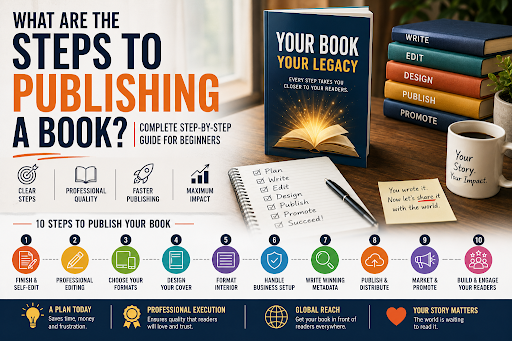
Every published author was once exactly where you are: finished manuscript (or a half-finished one), a browser full of conflicting advice, and no clear map from "I wrote something" to "my book is in readers' hands." The good news? The path to publishing a book is far more structured than the internet makes it seem. Whether you go the traditional route, choose self publishing, or work with professional book publishing services, the core steps are the same, only the person doing them changes.
This guide walks you through all ten steps in order, flags the mistakes beginners make at each stage, and covers a few decisions most guides skip entirely, like publishing paths beyond the usual two, and how to prepare your book for AI-driven discovery.
First, Choose Your Publishing Path
Before any step matters, you need to know who's publishing your book. Most guides present two options; there are actually four.
| Path | Who Pays | Royalties | Creative Control | Timeline | Best For |
|---|---|---|---|---|---|
| Traditional publishing | Publisher pays you (advance) | 5–15% | Low | 1–3 years | Authors with agents or strong platforms |
| Self publishing | You | 35–70% | Full | 3–9 months | Authors who want control and speed |
| Hybrid publishing | Shared / author-funded | 30–50% | High | 6–12 months | Authors who want support with ownership |
| Assisted self-publishing | You (service fees) | You keep 100% of royalties | Full | 3–6 months | First-timers who want expert execution |
That fourth path is the one beginners overlook: you retain all rights and royalties, but an experienced team handles editing, design, and distribution setup. It's the model we built Monarch Books Co around, because most first-time authors don't need a publisher to take their rights; they need a guide.
With your path chosen, here are the steps.
Step 1: Finish and Self-Edit Your Manuscript
No professional will (or should) work with a half-done draft. Before moving forward:
- Complete a full draft, then let it rest for 2–4 weeks before rereading. Distance reveals problems fresh eyes can't fake.
- Do a structural self-edit first (plot holes, pacing, chapter order), then a line-level pass. Fixing sentences in a chapter you'll later delete wastes weeks.
- Read problem sections aloud; clunky dialogue and rhythm issues are easier to hear than see.
Beginner mistake to avoid: polishing chapter one for months while the rest of the book stays rough. Momentum beats perfection in drafting.
Step 2: Get Professional Editing (In the Right Order)
Book editing isn't one service; it's a sequence, and doing it out of order costs money:
- Developmental editing — big-picture structure, character arcs, argument logic.
- Line editing — style, clarity, and flow at the sentence level.
- Copyediting — grammar, consistency, fact-checking.
- Proofreading — the final typo hunt after formatting.
A developmental edit typically runs $0.03–$0.08 per word; copyediting $0.02–$0.05. If budget forces a choice, prioritize developmental editing for fiction and copyediting for straightforward nonfiction.
Step 3: Decide Your Formats — Ebook, Print, Audio
Plan formats before design, because they affect cover dimensions, interior layout, and budget.
- Ebook: lowest cost, fastest to market, essential for every author.
- Print (paperback via print-on-demand): builds credibility, enables bookstore and event sales, requires a spine-width-specific cover.
- Audiobook: the fastest-growing format; consider it once ebook/print revenue proves demand.
Step 4: Commission a Professional Cover
Readers absolutely judge books by covers, especially at thumbnail size on retailer pages.
- Study the top 20 bestsellers in your exact subgenre; your cover should look like it belongs there while standing out.
- Test your design at 80-pixel width. If the title is unreadable, revise.
- Budget $300–$800 for quality custom design; premade genre covers start around $100.
Step 5: Format the Interior
Interior formatting (typesetting) determines whether your book feels professional. Ebook writing need reflowable EPUB files; print needs fixed layouts with correct margins, gutters, and front matter (title page, copyright page, table of contents). Tools like Vellum and Atticus handle both, or your production team does it as part of the package. Authors building digital editions often pair this with ebook writing and formatting support.
Step 6: Handle the Business Setup Most Guides Skip
This is where beginner guides go quiet and where problems surface later:
- ISBNs: Buy your own (through Bowker in the US) rather than using a retailer's free one, so you are listed as the publisher and can distribute anywhere. Each format needs its own ISBN.
- Copyright registration: Your work is copyrighted at creation, but formal registration (about $45–$65 in the US) is required before you can sue for infringement.
- Publishing imprint: Even solo authors can publish under a business name useful for taxes, credibility, and rights management.
- Sales tax and income setup: Retailers report your royalties; talk to an accountant about whether an LLC makes sense before revenue arrives, not after.
Step 7: Write Metadata That Sells
Metadata, such as your title, subtitle, description, categories, and keywords, is how readers find you.
- Book description:Write it like ad copy, not a synopsis. Hook, stakes, promise. Nonfiction descriptions should name the reader's problem in the first two lines.
- Categories:Choose narrow, winnable subcategories (e.g., "Cozy Animal Mystery" beats "Mystery").
- Keywords:Use phrases real readers search — think "enemies to lovers fantasy romance," not "good book."
The AI-Discovery Layer (What Competitors Don't Cover)
Readers now ask ChatGPT, Perplexity, and Google's AI Overviews for book recommendations. To be discoverable there, your book needs consistent entity signals: matching author name, title, and topic across your website, Goodreads, retailer pages, and interviews, plus a landing page with Book schema markup. Building this at launch, not later, is a genuine competitive edge almost no beginner guide mentions.
Step 8: Choose Distribution Channels
- Amazon KDP: non-negotiable for reach, but decide carefully on KDP Select, which pays page-read royalties in exchange for ebook exclusivity.
- Wide distribution: Draft2Digital or PublishDrive push your book to Apple Books, Kobo, Barnes & Noble, and, crucially, library platforms like OverDrive and Hoopla — a channel worth real money that exclusivity locks you out of.
- IngramSpark: gets print copies into bookstore ordering catalogs.
- Direct sales:selling from your own site via Payhip or Shopify yields the highest margins and, unlike retailers, gives you the customer's email.
Step 9: Build Your Launch Runway (60–90 Days Out)
A launch is built before publication day:
- Set up a simple author website and email list — the only marketing assets you fully own.
- Recruit an ARC (advance reader copy) team of 20–50 readers through StoryOrigin or BookFunnel so reviews land in week one.
- Line up podcast interviews, newsletter swaps, and community posts timed to launch week.
- Consider a preorder period to stack early sales into a single ranking spike.
Step 10: Publish, Then Keep Going
Upload your files, preview every format on real devices, order a physical proof copy, and hit publish. Then remember: launch week is the starting line. Books that sell for years are promoted in cycles of price promotions, new reviews, seasonal pushes, and eventually a series or follow-up title that lifts the whole backlist.
How Much Does It Cost to Publish a Book?
Realistic beginner budgets, doing it right:
- Lean DIY: $500–$1,500 (premade cover, copyedit only, free formatting tools)
- Standard professional: $2,000–$5,000 (full editing sequence, custom cover, formatting)
- Full-service support: $3,000–$8,000+, depending on scope
Costs vary widely between providers, which is why comparing quotes matters. A genuinely affordable book publishing agency will itemize every service and let you keep 100% of your rights and royalties, while overpriced outfits bundle vague "marketing packages" into five-figure contracts. If a company pressures you to sign quickly or won't explain what you're paying for, walk away. At Monarch Books Co, we tell authors the same thing whether they hire us or not: never trade your rights for services you could simply pay for.
frequently  asked questions
How long does it take to publish a book for the first time?
With self-publishing, plan 3–6 months from finished manuscript to launch: 6–10 weeks for editing rounds, 3–4 weeks for cover and formatting, and 4–8 weeks of pre-launch marketing. Traditional publishing typically takes 1–3 years after securing an agent.Do I need an agent to publish a book?
Only for traditional publishing with major houses. Self-publishing, hybrid publishers, and assisted publishing services require no agent — you deal directly with retailers or your production team.Can I publish a book with no money?
Technically, yes: free formatting tools, a DIY cover, and KDP's free upload make a $0 launch possible. But skipping professional editing and cover design is the most common reason first books underperform. A modest $500–$1,500 budget dramatically improves your odds.Should I buy my own ISBN or use Amazon's free one?
Buy your own if you plan to distribute beyond Amazon or want your imprint listed as the publisher. Amazon's free ASIN/ISBN works only within Amazon and lists them in the publisher field.What's the difference between hybrid publishing and assisted self-publishing?
Hybrid publishers act as the publisher; they take a royalty share and control some decisions. Assisted self-publishing means you remain the publisher of record, pay flat fees for professional services, and keep 100% of royalties and rights.


