
ChatGPT vs Gemini AI for Book Writing and Editing: Detailed Guide
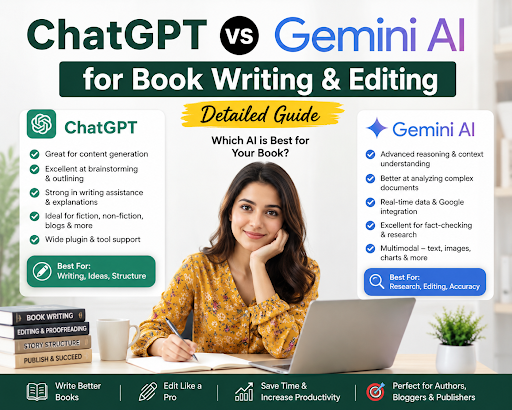
You've probably already poked around with ChatGPT or Gemini while working on your book. Maybe you typed in a scene and thought, "Huh, that's actually pretty good," or maybe you fed it your whole manuscript and watched it completely lose the plot by chapter ten, which is exactly why so many authors still turn to ebook writing services instead of going it alone. Both reactions are normal because these two tools are honestly not playing the same game.
ChatGPT feels like a co-writer who gets your voice. Gemini feels more like a research assistant with a freakishly good memory. Neither one is "the best AI," full stop; it really comes down to which part of writing a book you're stuck on.
Quick Comparison: ChatGPT vs Gemini for Authors
| Feature | ChatGPT (GPT-5.4) | Gemini (3.1 Pro) |
|---|---|---|
| Context window | 272,000 tokens | 1 million tokens |
| Output length per response | Up to 32,000 tokens | Up to 65,000 tokens |
| Best for | Voice, narrative, dialogue | Full-manuscript continuity |
| Multimodal input | Text, limited image | Text, image, audio, video |
| Code/data tools | Built-in Python sandbox | Code generation, no execution |
| Fact-checking tendency | More hallucinations on real-time facts | Lower hallucination, Google-grounded |
That context window gap isn't just a spec sheet flex. Gemini's million-token window can swallow about 8.4 hours of audio, a 900-page PDF, or a full hour of video in a single go, and it can spit back up to 65,000 tokens, more than double what ChatGPT's 32,000-token cap allows. Translation: Gemini can hold your entire 90,000-word draft in its head at once. ChatGPT, most of the time, needs you to feed it in chunks.
Where ChatGPT Just Feels Better: Voice and Dialogue
Here's the thing: nobody can really fake it. When you read ChatGPT's writing versus Gemini's, you can tell. In one head-to-head creative writing test, ChatGPT wrote a short story with more emotional texture and cinematic feel, while Gemini's version came out more straightforward and matter-of-fact. That tracks with what a lot of authors quietly say once you ask them off the record.
You'll notice it most in:
- Dialogue that sounds like two people actually talking, not two people reading lines
- Tonal shifts — tense scene, then a quiet beat, then back up
- A character's "voice" staying consistent within one chapter
- Genre instincts: thriller pacing versus a slow literary unfold versus rom-com banter
It also handles layered instructions better. ChatGPT tends to follow nuanced, multi-part prompts more reliably and makes fewer mistakes on complicated multi-step requests so when you say "rewrite this in the past tense, tighten it, but keep Maya's sarcasm," it's more likely to actually do all three things instead of just one.
Where Gemini Pulls Ahead: It Doesn't Forget Your Book
This is the part that genuinely surprised me. Once your manuscript gets long enough that you start losing track of small details, what colour were Maya's eyes again? Didn't this character already leave town in chapter 6? Gemini's memory becomes the real selling point.
Gemini 3.1 Pro, which came out in February 2026, runs on native multimodal understanding plus that million-token window, so you can dump your entire draft in and just ask: "Did I contradict myself anywhere?" ChatGPT can technically do this too, but you're usually re-pasting sections as you go because it just can't hold as much at once.
Genuinely useful for:
- Catching timeline slip-ups across a long book
- Checking your whole draft against a style guide in one pass
- Reviewing a full nonfiction manuscript against your research notes without breaking it into pieces
If You're Writing Nonfiction, This Part Matters
If facts and dates and "did this actually happen this way" matter to your book, pay attention here. Gemini tends to hallucinate less on factual, time-sensitive stuff because it leans hard on Google's search index, while ChatGPT slips up more on real-time facts but stays more solid on timeless, explanatory writing.
So ask Gemini to verify a date or a stat; it's a bit more trustworthy. Ask ChatGPT to explain a tricky concept clearly or restructure a messy argument, and it usually holds up better.
Editing: Not the Same Job, Not the Same Tool
Editing splits the same way drafting does, honestly:
- Line edits (grammar, flow, word choice) — ChatGPT tends to win. Cleaner prose, better at respecting your tone notes.
- Structural edits (pacing, plot holes, chapter order)— Gemini, because it can actually "see" the whole book while it's thinking.
- Fact and consistency edits — Gemini again, same reason as above.
- Data or code appendices— ChatGPT's built-in Python sandbox lets you write, run, and debug code right in the chat, which is genuinely handy if your book has charts or technical sections. Gemini will write code for you, but it just won't run it the same way.
And look, neither one replaces a real editor. AI catches a dangling modifier just fine. It will not tell you why chapter three feels flat, because it's not actually feeling anything; it's predicting what sounds correct. That's usually exactly where book editing services still earn their money; they catch the stuff a model just glosses over.
The Multimodal Thing Nobody Talks About
This part gets skipped in most comparisons, but it matters if you write the messy, real way, half-recorded voice notes, scribbled outlines, that kind of thing.
Gemini handles images, video, and audio natively, so you can:
- Hand it a voice memo you recorded in the car, and have it clean up the rough transcript
- Upload a photo of your whiteboard plot map
- Feed it a screenshot with text in it, since it tends to pull out more detail than ChatGPT does with OCR-style stuff
ChatGPT does some image input, sure, but it's not really built around audio and video the way Gemini is. If a chunk of your process is dictation or scribbled notes, Gemini just fits better.
How I'd Actually Use Both
Most authors aren't loyal to one tool; they bounce between them depending on what's broken that day:
- Drafting a chapter → ChatGPT, for the voice
- Checking the whole manuscript makes sense → Gemini, for the memory
- Verifying a fact or date → Gemini, for the grounding
- Polishing dialogue → ChatGPT
- Cleaning up a dictated voice note → Gemini
- Final structural pass before it goes to an actual person → Gemini, then a human
Where AI Just Stops Being Enough
AI is great for speed. It's great for momentum on a day you'd otherwise stare at a blank page. What it won't do is tell you your protagonist's motivation doesn't add up, or that your nonfiction intro buries the actual hook three paragraphs too late. That's a human thing. It's exactly why authors juggling day jobs, deadlines, or just too many drafts end up leaning on an ebook writing agency to get the heavy lifting done, then bringing in book editing services for the final pass before anything goes out into the world.
Bottom Line
There's no clean winner here, and I think that's the honest answer. ChatGPT carries your voice. Gemini carries your whole book in its head. Use them together with an actual human still checking the final draft, and you'll cover a lot more ground than either one manages alone.
Frequently asked questions
Which AI is better for writing a novel, ChatGPT or Gemini?
It depends on what's bugging you. Need your characters to actually sound like people? ChatGPT. Keep losing track of who said what three chapters ago? Gemini's the one with the memory.Can Gemini really hold an entire book in one conversation?
Yeah, pretty much. You can dump your whole draft in, and it'll actually remember all of it. ChatGPT starts forgetting earlier chapters once you've fed it too much, so you end up working in chunks instead.Is ChatGPT or Gemini more accurate for fact-checking a nonfiction book?
Gemini, slightly. It leans on Google's search data, so it's a bit more trustworthy when you're double-checking a date or a stat in your manuscript.Should I use both ChatGPT and Gemini for the same book?
Honestly, a lot of people already do without even labelling it that way. Draft and dialogue in ChatGPT, then run the finished chapters through Gemini for continuity and fact-checks. They just cover different weak spots.Can AI replace a professional book editor?
Nope. They're great at fixing typos and awkward sentences, but they won't catch that your protagonist's motivation falls apart in chapter 12. That's still a human job, which is why people still bring in a book editing company before hitting publish.


