
4 Ways AI Could Change Book Publishing in 2026
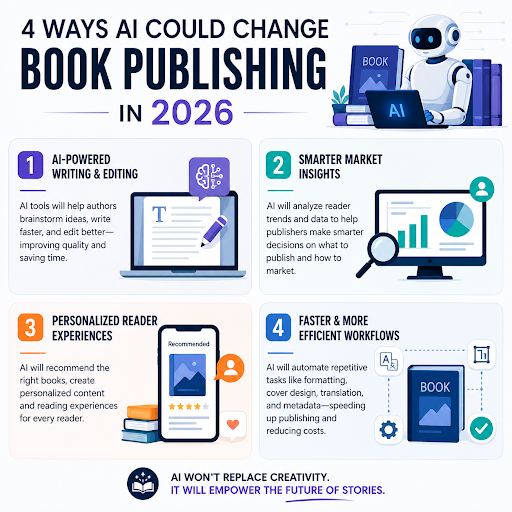
Ask ten authors what "AI in publishing" means and you'll get ten different answers — some picture a robot writing their novel, others picture a faster route to Amazon's bestseller list. Neither is quite right.
What's actually happening in 2026 is less dramatic and more structural: AI is quietly rewiring the workflow behind every book that goes to market — how manuscripts get edited, how covers get designed, how readers discover new titles, and how distribution decisions get made. Authors who understand this shift are publishing faster and smarter. Authors who ignore it are competing against a market that's moving without them.
This isn't a "should you use AI to write your book" article. It's a breakdown of where AI is genuinely changing outcomes for authors working with a book publishing company, and where the hype still outpaces the reality. If you're trying to decide how to publish a book in 2026 — traditionally, through a hybrid model, or via Amazon KDP — this is the operational picture you need before you make that call.
Why This Matters More Than It Did Two Years Ago
Publishing has always been a pipeline: manuscript → edit → design → format → distribute → market. For decades, each stage was a separate bottleneck, usually solved by hiring separate specialists.
AI hasn't eliminated that pipeline. It has compressed parts of it and exposed which stages actually require human judgment versus which were always just labor-intensive pattern matching. That distinction is the whole story of AI's impact on publishing in 2026.
If you're evaluating self publishing services or comparing them against a traditional deal, understanding which stages are genuinely AI-augmented — and which still need a human editor, designer, or strategist — will save you money and protect your book's quality.
1. Manuscript Editing Gets a First-Pass Layer — But Not a Replacement
The biggest and most defensible change is at the editing stage, specifically at the developmental and line-editing triage level.
What's Actually Changing
AI editing tools in 2026 can now:
- Flag structural pacing issues (sagging middles, rushed climaxes) by mapping tension across chapters
- Catch continuity errors across a 90,000-word manuscript in minutes — character eye color changing, timeline contradictions, plot holes
- Surface repetitive phrasing, overused sentence structures, and voice inconsistency
- Generate a "developmental report" that used to take a human editor 15–20 hours to produce manually
This is genuinely useful. It means when an author works with a professional editor today, that editor isn't spending billable hours hunting for continuity errors — they're spending it on the things AI still can't judge well: tone, emotional authenticity, whether a plot twist actually lands, whether a memoir's voice feels honest instead of performative.
What Isn't Changing
Here's where a lot of self-publishing advice gets sloppy: AI editing tools are pattern-matchers, not story judges. They will confidently flag a stylistic choice as an "error" when it's actually a deliberate craft decision — a sentence fragment for emphasis, an unreliable narrator's inconsistency by design. Relying on AI editing alone produces technically clean manuscripts that often read flat, over-corrected, and stripped of voice.
Practical takeaway:Use AI editing as triage, not verdict. A manuscript that's gone through AI-assisted structural analysis and a human developmental editor is arriving at that second stage more efficient and cheaper than it would have two years ago — that's the real 2026 shift, not editor replacement.
If you're comparing book publishing services for your manuscript, ask specifically whether their editing process uses AI as a first-pass diagnostic layered under human editors, or whether it's being sold as a replacement for one. That answer tells you a lot about the quality you'll actually get.
2. Cover Design and Formatting Get Faster — With a New Quality Trap
Cover design and interior formatting are the two production stages where AI has made the most visible, immediate difference — and also where authors are most likely to shortcut themselves into a worse outcome.
Where AI Genuinely Helps
- Rapid concept iteration: Designers can generate 10–15 visual directions in the time it used to take to mock up two, letting authors and art directors converge on a concept faster
- Genre-comparable analysis: AI tools can now analyze bestseller covers within a specific sub-genre (dark academia, cozy mystery, epic fantasy) and flag whether a draft cover matches reader expectations for that shelf — a real factor in whether a cover converts browsers into buyers
- ebook formatting automation: Reflowable EPUB formatting, front matter generation, and table-of-contents linking — traditionally tedious, error-prone manual work — is now largely automated with far fewer formatting errors reaching final files
The Quality Trap
Fully AI-generated covers, published without a professional designer's eye, have a specific problem in 2026: they're statistically over-represented in the "obviously AI" bucket that readers — and increasingly, retailers — can spot. Amazon and other retailers have tightened AI-content disclosure requirements, and covers that look generic or slightly "off" (a known AI-image tell) actively hurt click-through rate on browse pages.
Practical takeaway: Use AI for speed in the ideation phase. Keep a professional designer in the loop for final execution, especially for genre fiction where cover conventions are a real purchase signal, not decoration.
This is also why the packaging you choose matters as much as the manuscript. A strong book publishing company will treat AI-assisted design as a starting point for a human designer, not the finished deliverable — that distinction is worth asking about directly before you sign anything. Monarch Books Co breaks down what a full production pipeline should actually include if you want to see how the stages should connect.
3. Book Marketing and Discoverability Are Being Rebuilt Around AI Search
This is the change with the biggest long-term impact, and the one most authors are underprepared for: how readers find books is shifting from keyword search to AI-mediated discovery.
What's Happening
- Readers increasingly ask AI assistants (ChatGPT, Gemini, AI Overviews in Google) for book recommendations directly — "recommend a memoir like Educated but set in the Midwest" — instead of browsing Amazon categories
- These AI systems pull from a blend of retailer metadata, review sentiment, blog coverage, and structured data (schema markup) about a book, not just sales rank
- Author websites, press coverage, and well-optimized book description pages are becoming inputs to AI recommendation engines, not just SEO traffic sources
- Amazon's own AI-driven "customers also bought" and review-summary features are changing what makes a product page convert
What This Means Practically
Book marketing in 2026 isn't just Amazon ads and BookBub deals anymore — those still matter, but they're no longer sufficient on their own. Discoverability now depends on:
- Structured, consistent book metadata across every platform (title, subtitle, series info, BISAC categories) so AI systems can accurately match your book to a reader's query
- Author entity building — a coherent online presence (author website, consistent bio, press mentions) that AI search engines can cross-reference to establish credibility, similar to how E-E-A-T works for regular web content
- Genuine review depth, since AI summarization tools increasingly synthesize review sentiment rather than just counting star ratings
Practical takeaway:If your book marketing plan is still 100% built around Amazon ad spend and nothing else, you're optimizing for a discovery model that's already partially outdated. Authors who want their book to surface when a reader asks an AI assistant for a recommendation need to think about entity signals and metadata the same way SEO practitioners think about topical authority.
This is exactly the strategic layer where working with an experienced book publishing company pays off — most solo authors don't have the bandwidth to manage editorial production and build AI-discoverable metadata and author entity signals at the same time.
4. Distribution and Publishing-Path Decisions Are Getting More Data-Driven
The fourth shift is quieter but strategically significant: AI is changing how authors and publishers decide where and how to publish — not just how they produce the book.
What's Changing
- Comparative platform analytics now model expected royalty outcomes across Amazon KDP exclusivity (KDP Select) versus wide distribution (IngramSpark, Apple Books, Kobo, etc.) based on genre, category competitiveness, and pricing data — decisions that used to rely on forum anecdotes now have actual modeling behind them
- Pricing and category optimization tools analyze real-time category saturation and suggest launch pricing and category placement more precisely than manual research allowed
- Hybrid publishing decision-making — traditional vs. self-publishing vs. hybrid — increasingly draws on AI-assisted market comparables: how similar books in your genre and comp-title range actually performed, not just gut instinct
Why This Matters for Your Decision
If you're trying to figure out how to publish a book in the current environment, the honest answer is: it depends on data most authors don't have easy access to — comparable title performance, category competition levels, and realistic royalty modeling across paths. AI tools have made that data more accessible, but interpreting it correctly still requires publishing industry experience.
This is where the "publish my book" decision gets genuinely complicated for first-time authors. Self-publishing gives you speed and control; traditional publishing gives you distribution reach and advance funding but a much longer timeline and far more rejection risk; hybrid models split the difference. AI-assisted market modeling can now tell you, reasonably accurately, which path fits your specific book's genre and positioning — but someone still has to interpret that data and build the actual production and launch plan.
Practical takeaway:Don't choose a publishing path based on which one sounds more prestigious. Choose it based on comparable-title data for your specific genre, your timeline, and your budget. A book publishing company with real production experience can run that comparison for you faster and more accurately than solo research will.
What Isn't Changing (And Why That Matters)
It's worth being direct about this, because a lot of publishing content overstates AI's role: the fundamentals of what makes a book sell — a strong hook, clean prose, a cover that signals genre correctly, a launch plan with real marketing behind it — haven't changed at all. AI has changed the efficiency of getting there, not the bar for getting there.
Authors who treat AI as a shortcut around craft, editing, and strategic planning are producing books that are technically faster to finish and measurably worse in the market. Authors who treat AI as a production accelerant — freeing up budget and time to invest in things that still need a human (deep editing, strategic marketing, genre-accurate design) — are the ones actually benefiting from this shift.
If you're deciding whether to handle this shift alone or bring in book publishing services to manage it, the honest test is this: can you personally keep up with AI-driven changes in editing tools, retailer algorithms, and discovery mechanics while also writing your next book? Most authors can't do both well, which is exactly the gap professional publishing partners are built to close. You can see how Monarch Books Co structures its full publishing process around these exact production stages.
Final Thoughts: Publishing Smarter in 2026
AI hasn't changed what makes a book succeed. It has changed how fast the supporting work — editing triage, design iteration, metadata structuring, and distribution modeling — can happen around a manuscript that still needs genuine craft and strategic marketing behind it.
If you're trying to figure out how to publish a book this year, start by being honest about which parts of the process you can realistically manage alone and which parts need experienced hands. Authors who combine AI's speed with real editorial, design, and marketing expertise are the ones seeing measurably better launches in 2026 — not the ones who used AI to skip steps.
If you want a production partner that already has this workflow built — human expertise layered over the right AI tools at each stage — Monarch Books Co. works across editing, design, formatting, and distribution strategy for authors publishing this year.
frequently  asked questions
Will AI replace human editors in book publishing?
No — not in any near-term sense. AI is effective at catching structural and continuity issues (pacing, consistency, repetition) but consistently underperforms at judging voice, emotional authenticity, and deliberate stylistic choices. The 2026 standard is AI-assisted triage followed by human developmental and line editing, not AI editing alone.How is AI changing book marketing for authors?
Book discovery is shifting from pure keyword search toward AI-mediated recommendations through tools like AI Overviews and conversational AI assistants. This makes structured metadata, consistent author branding, and genuine review depth more important, because AI systems draw on these signals to recommend books — not just Amazon sales rank alone.Should I use AI to design my book cover?
Use AI for fast concept iteration, but have a professional designer execute the final cover. AI-generated covers published without human refinement are increasingly easy for readers — and retailers — to identify as low-effort, which can hurt click-through and conversion on a book's product page.Is self-publishing better than traditional publishing in 2026 because of AI tools?
Neither is universally "better" — AI has made it easier to model which path fits a specific book, based on genre, comparable titles, and category data. Self-publishing still offers more speed and control; traditional publishing still offers wider distribution and advance funding but a slower, more selective process. The right path depends on your goals and your book's genre positioning, not on which method uses more AI.How do I know if a book publishing company is using AI responsibly?
Ask directly what stage AI is used at (editing triage, formatting, initial design concepts) and whether a human professional reviews and finalizes every stage before publication. A publisher that can answer that specifically — rather than vaguely claiming "AI-powered publishing" — is more likely to deliver a quality outcome.


