
The 5 Marketing Strategies We Used to Help My Wife Become a Six-Figure Author
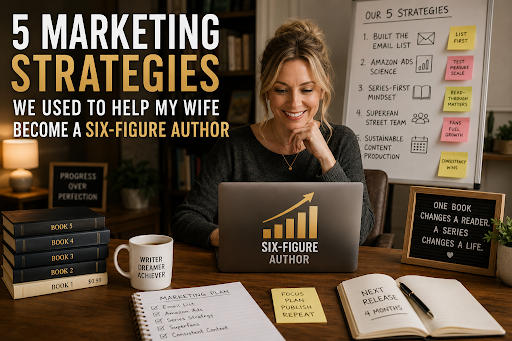
Three years ago, my wife Sarah was refreshing her Amazon dashboard every twenty minutes, watching her debut novel sell four copies a week. Two of those were to her mom. Last year, she crossed $100,000 in annual author income for the first time, and this year she's on pace to beat it.
I run Monarch Publishing, so I've watched hundreds of authors try to crack this code. But nothing teaches you like doing it inside your own house, with your own money, and a spouse who reminds you daily when something isn't working. What follows isn't theory. It's the exact five-strategy playbook we built through trial, error, and a few arguments over the dinner table.
Strategy 1: We Built the Email List Before We Built Anything Else
Everyone told us to focus on social media. We ignored them, and it was the best decision we made.
Here's the uncomfortable truth about author platforms: you don't own your Instagram followers. An algorithm change can wipe out your reach overnight. An email list, on the other hand, is a direct line to readers that no platform can take from you.
Sarah created a free prequel novella, a 15,000-word story set in the same world as her series, and offered it as a reader magnet. Anyone who wanted it had to join her newsletter. We promoted it through free platforms like BookFunnel group promotions and newsletter swaps with authors in her genre.
The numbers tell the story. In month one, she had 212 subscribers. By the end of year one, she had 9,400.
When she launched her third book, she emailed that list and hit the Amazon Top 100 in her category within 48 hours, with zero ad spend on launch day.
What you can copy:Write a short piece of bonus content connected to your main book. Set up a simple landing page. Trade newsletter swaps with three authors in your genre every month. That's it. Boring, unglamorous, and wildly effective.
Strategy 2: We Treated Amazon Ads Like a Science Experiment, Not a Slot Machine
Our first month running Amazon ads, we lost $340. Sarah wanted to quit. I convinced her to give it ninety days, but with one condition: we'd stop guessing and start testing.
Most authors treat pay-per-click advertising like a lottery ticket. They throw money at broad keywords, panic when they don't see instant sales, and shut everything down. We flipped the approach:
- We started with 50 hyper-specific keywords, mostly comparable author names and book titles in her exact subgenre, not generic terms like "romance novel."
- We set tiny budgets, five dollars a day per campaign, and let them run for two weeks before touching anything.
- We killed losers ruthlessly and scaled winners slowly. Any keyword that spent $10 without a sale got paused. Any keyword with a strong conversion rate got a bid increase of 10 percent, never more.
By month four, her ads were profitable. By month twelve, every dollar we put into Amazon advertising returned roughly $2.40 in royalties, and that's before counting read-through to the rest of her series.
The lesson: book promotion isn't about spending more, it's about measuring more. If you can't stomach spreadsheets, this is exactly the kind of thing professional book marketing services handle for authors every day, and honestly, outsourcing it earlier would have saved us that painful first quarter.
Strategy 3: We Engineered Read-Through With a Series-First Mindset
Here's a hard financial reality: it's very difficult to earn six figures from one book. Sarah doesn't sell one book to each reader. She sells five.
Before writing book two, we mapped out a five-book series and made deliberate structural choices to maximize read-through, the percentage of readers who finish one book and buy the next:
- Book one is permanently priced at $0.99. It's not a profit center. It's a customer-acquisition tool.
- Every book ends with an emotional hook (not a cheap cliffhanger, readers hate those, but an open question they genuinely want answered).
- The back matter of every ebook includes a one-click link to the next book, plus the newsletter signup.
Her read-through rate from book one to book two sits at 68 percent. From book two onward, it's above 80 percent. That means a single $0.99 sale is actually worth around $12 in lifetime royalties. Once we understood that math, our whole approach to advertising changed, because we could afford to spend more to acquire each new reader than any single-book author could.
What you can copy: Think in series or connected standalones. Price your entry point low. Make buying the next book frictionless. Your backlist is your business model.
Strategy 4: We Built a Street Team of Superfans (and Actually Took Care of Them)
Reviews are social proof, and social proof sells books. But begging strangers for reviews is exhausting and mostly futile. Instead, we built an advanced reader team, a group of genuine fans who receive every new book early in exchange for honest reviews on launch day.
We recruited them directly from the email list with one simple message: "Want to read the next book before anyone else?" Within a week, 300 people applied. We accepted 150.
The part most authors get wrong: they treat ARC readers like free labor. We treated ours like VIPs. Sarah sends them personal thank-you notes, names minor characters after long-time members, and gives them the first vote on cover options. The result? Her last launch went live with 87 reviews in the first week. Amazon's algorithm noticed that her also-bought placements improved, and organic sales followed.
Author branding isn't a logo or a color palette. It's the relationship your readers feel they have with you. Superfans are that relationship made visible.
Strategy 5: We Made Content Production Sustainable (Because Burnout Kills Careers)
The strategy nobody talks about: publishing consistently is a marketing strategy. Every new release wakes up the algorithm, re-engages the email list, and gives ads fresh material. Authors who release one book every three years are marketing on hard mode.
But Sarah is one person with a day job; she only recently quit. So we got strategic about production:
- She writes the books that only she can write, her series fiction, in focused morning blocks.
- For her nonfiction companion guides and some marketing copy, we brought in outside help. Professional ghostwriting services and freelance editors let her keep a steady release schedule without sacrificing the quality of her core novels.
- We batch everything: cover design for two books at once, ad creative for the quarter, newsletter content a month ahead.
The outcome is a release every four to five months, which keeps her visible on Amazon, keeps her list warm, and keeps the whole flywheel spinning.
The Honest Summary
If you're looking for a shortcut, I don't have one. What we have is a repeatable system: own your audience through email, advertise with discipline, structure your catalog for read-through, cultivate superfans, and publish consistently without burning out.
None of these strategies worked alone. The email list made the launches work. The launches made the ads cheaper. The ads fed the series funnel. The series funnel funded everything else. Six-figure author careers aren't built on one viral moment; they're built on five boring systems that compound.
Sarah still refreshes her dashboard, by the way. She just smiles more now.
frequently  asked questions
How long does it take to become a six-figure author?
For Sarah, it took just under three years from her first book to her first $100K year. Most successful indie authors we work with at Monarch Books Co see meaningful income between books three and five, assuming consistent releases and active marketing. One book is rarely enough; a catalog is what earns.How much should I budget for book marketing as a new author?
Start small. We recommend $150 to $300 per month for Amazon ads while you learn, plus the cost of a professional cover and editing, which are non-negotiable. Your marketing budget should scale with proof: only increase spend once your data shows a positive return.Do I really need an email list if I'm active on social media?
Yes. Social media reach is rented; your email list is owned. Sarah's newsletter converts at roughly ten times the rate of her social posts. Use social media to attract readers, but always funnel them toward your list.What's the biggest mistake new authors make with book launches?
Launching to nobody. A launch without an email list, an ARC team, or early reviews is a launch the algorithm can't see. Spend the six months before your release building an audience, even a small one, so launch day has momentum.Is it worth hiring professionals instead of doing everything myself?
It depends on your time and skills. Many authors happily run their own ads and newsletters. But if marketing tasks are stealing your writing hours, outsourcing to specialists often pays for itself, because the most valuable thing an author can produce is the next book.


