How to Find Professional Ghostwriting Services and Avoid Costly Scams in 2026
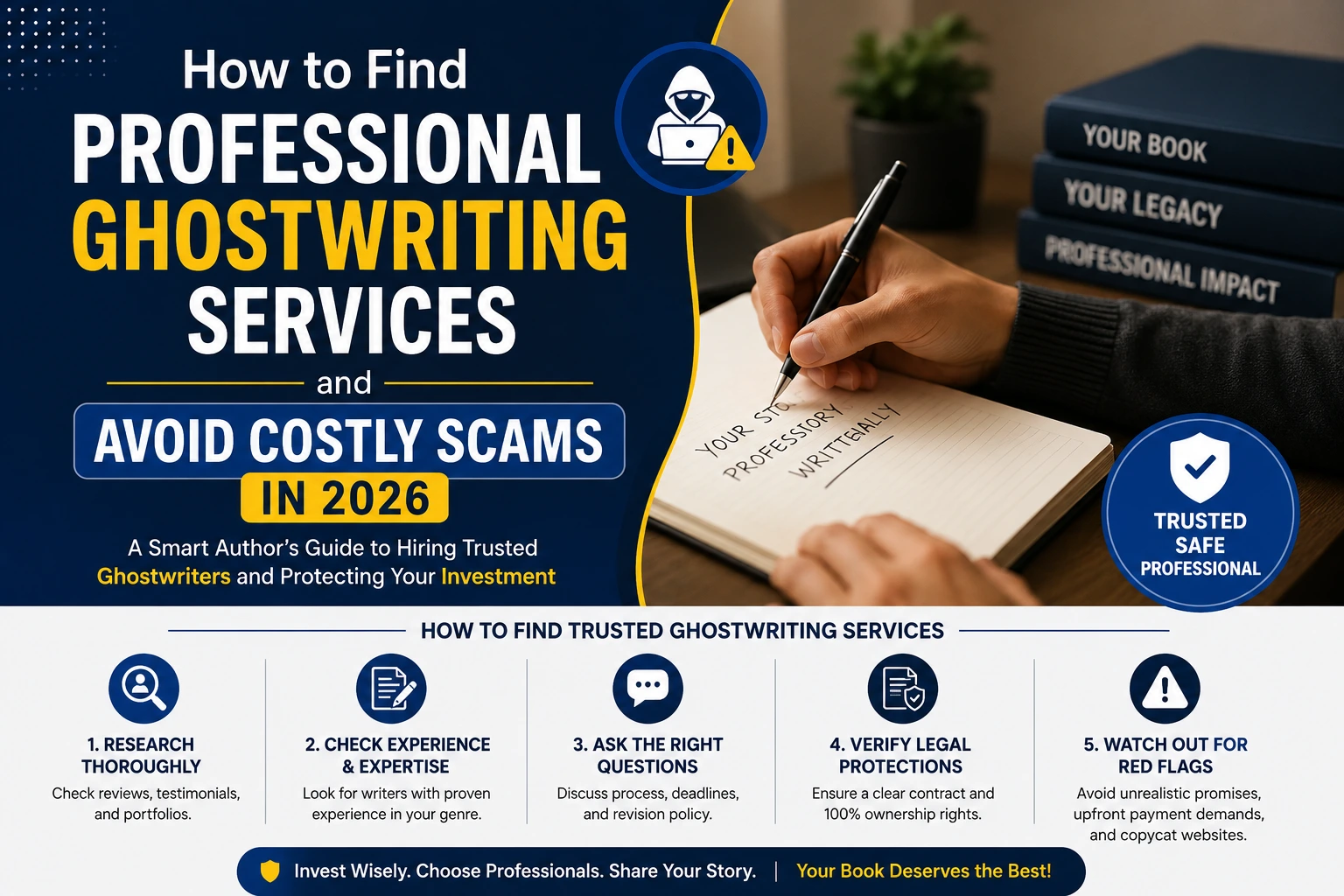
Human voice is the scarcest commodity in modern publishing — and the market is pricing it accordingly. The global ghostwriting services market is projected to reach $1.53 billion in 2026, growing at a 7.8% CAGR. That number tells a story most aspiring authors miss: demand is not shrinking because of AI — it is accelerating.
The flood of machine-generated content across every platform has done something counterintuitive. It has made readers, publishers, and audiences sharper at detecting inauthenticity. The bar for professional ghostwriting services has never been higher.
Dan Gerstein, CEO of Gotham Ghostwriters, put it plainly: "AI is actually making what we do more valuable by highlighting the limitations of machine-generated text." What gets lost in AI output is not grammar — it is the singular perspective, earned authority, and tonal consistency that make a book worth reading.
Today's most successful author clients are not hiring ghostwriters to transcribe their thoughts. They are engaging collaborators who understand competitive positioning, audience psychology, and how a book fits inside a broader brand or business strategy. A ghostwriter in 2026 is as much a strategist as a writer.
The High Cost of Cheap: Spotting 2026 Ghostwriting Scams
The single most reliable predictor of a ghostwriting disaster is a price that feels too good to be true — because in this industry, it always is. According to Monarch Books Co., any quote under $10,000 for a full-length book is a significant red flag — one that signals AI-generated filler, offshore outsourcing, or both.
Legitimate professional ghostwriters command higher rates because authentic human voice, deep research, and structural storytelling expertise take hundreds of hours to deliver. The "ghostwriting mill" is a real and growing problem in 2026. These operations market themselves with polished websites and impressive credentials, but the actual work is farmed out to low-cost AI pipelines or overseas contractors with little editorial oversight.
The finished manuscript may technically fill the page count — but it reads like a prompt response, not a book. Here are the key red flags to watch for:
| Red Flag | What It Signals | Risk Level |
|---|---|---|
| Quote under $10,000 | AI filler or offshore outsourcing | High |
| Generic portfolio | The writer cannot adapt to your voice | High |
| No copyright clause | You may not own the manuscript | Critical |
| Unverifiable testimonials | Fabricated social proof | Medium |
| Vague revision policy | Hidden fees, no accountability | Medium |
| No trial chapter offered | The writer avoids quality scrutiny | Medium |
The 8 Most Lucrative Ghostwriting Niches in 2026
Not every ghostwriter commands the same rates. Knowing where premium demand lives helps you find the right ghostwriter before you waste months searching in the wrong places. The most lucrative ghostwriting services in 2026 cluster around sectors where authority and trust directly translate to revenue.
- Business Leadership and Founder Brand Books — Executives and startup founders increasingly use a published book as the centerpiece of their thought-leadership strategy. These projects rarely appear on public job boards — they move through referral networks and literary agents. Ghostwriters in this niche need to understand market positioning, board-level language, and corporate narrative arc.
- High-Concept Fiction and World-Building — As streaming platforms and gaming studios continue acquiring IP, demand for original fictional universes has intensified. Ghostwriters with strong genre credentials — science fiction, fantasy, thriller — are fielding briefs from entertainment companies that need a complete, publishable world built from a single premise.
- Memoir (Private and Commercial) — Memoirs are split into two distinct markets: private legacy projects commissioned by wealthy families who want a preserved record never intended for retail shelves, and public-consumption narratives aimed at traditional or self-publishing distribution. Understanding the publishing path before hiring shapes the type of ghostwriter you actually need.
- Ebook Ghostwriting for Lead Generation — B2B brands in tech and finance have recognized that a well-written ebook converts cold prospects far better than a landing page alone. These projects are shorter but highly technical, demanding writers who can translate complex financial instruments or SaaS architectures into persuasive, readable prose.
- Self-Help and Personal Development — Self-help continues to dominate bestseller charts. Authors in coaching, wellness, and productivity hire ghostwriters who can distill their frameworks into structured, commercially viable books with mass-market appeal.
- True Crime and Investigative Narrative — Podcast and documentary culture has driven renewed interest in long-form investigative writing. Ghostwriters with journalism backgrounds command premium rates in this category, where research accuracy and narrative pacing are non-negotiable.
- Children's Books and Educational Content— The children's publishing market remains robust, with independent creators and educational brands commissioning ghostwriters for series-based content. Shorter page counts do not mean lower complexity — age-appropriate voice matching requires specific craft.
- Academic and Research-Adjacent Ghostwriting — Thought leaders, researchers, and consultants commission ghostwriters to turn white papers, case studies, and proprietary research into published books that build institutional credibility. Learn more about how professional fiction writing and nonfiction services intersect in full-service publishing models.
How to Hire a Ghostwriter for Your Book: The Vetting Framework
Choosing the right hire ghostwriter partner comes down to one thing: verifiable evidence of craft and process. Before you commit anywhere from $25,000 to $75,000 for a professional book project, you need a repeatable vetting framework.
Review portfolios for voice consistency. Ask for writing samples across at least two different genres or subject areas. A skilled ghostwriter adapts tone without losing narrative cohesion. If every sample sounds identical — same sentence rhythm, same vocabulary range — that signals limited range, not mastery.
Demand a paid trial chapter. This is non-negotiable. No serious ghostwriter should refuse a paid sample, and no serious client should skip one. A short paid chapter — typically 1,500 to 3,000 words — reveals how well the writer absorbs your voice from an interview before you are locked into a full contract.
Check for specialist credentials."Bestseller Ghost" credentials — such as verified credits on books that reached major charts — carry weight that general content-writing portfolios do not. Ask directly whether the ghostwriter has worked in your specific niche, whether that is memoir, business strategy, or narrative nonfiction.
Verify their process end-to-end. A professional will walk you through a defined workflow: intake questionnaire, interview sessions, research methodology, chapter drafting, and revision rounds. Vague answers here are a red flag. The process should be documented, not improvised.
Why USA-Based Professional Ghostwriting Services Matter
Working with a US-based ghostwriter is not just a geographic preference — it is a strategic decision that directly affects the quality, legal security, and marketability of your finished book.
- American English nuance. Regional idioms, culturally specific references, and the rhythm of American prose are things native US writers internalize over a lifetime. Offshore outsourcing frequently introduces subtle tonal mismatches that trained editors and discerning readers catch immediately.
- Legal protection. US copyright law grants you clear, enforceable rights over work produced under a ghostwriting agreement. Disputes with offshore providers — even those operating through US-facing platforms — can quickly become jurisdictional nightmares with no practical remedy.
- Time zone alignment. Intensive interview sessions require real-time collaboration. A six-to-twelve-hour time difference compresses that window to near-zero and often forces one party into inconvenient hours, degrading the quality of the conversation and the manuscript.
- Publishing network access. US-based ghostwriters come embedded in American publishing and marketing networks — relationships with editors, literary agents, and publicists that offshore providers simply do not have. This network advantage extends to specialized services like ebook writing, where US-based teams understand domestic retailer requirements, metadata standards, and platform-specific formatting from day one.
Beyond the Manuscript: The Manuscript-to-Market Advantage
A finished manuscript is not a published book — and in 2026's crowded marketplace, the gap between those two things can determine whether your work reaches readers or disappears entirely. A great manuscript without professional editing, cover design, and marketing is still an unpublished idea.
Ghostwriting services that stop at the final draft leave authors stranded at the most technically demanding stage of the publishing journey. Structural editing alone can take weeks; developmental feedback, line editing, and proofreading are separate disciplines that require separate expertise.
Cover design is not decoration — it is the primary sales signal your book sends to every browser, retailer algorithm, and social media scroll.
The technical complexities do not end with design. The difference between an ebook and a print-ready file is significant. Ebook formats (EPUB, MOBI) require reflowable text, optimized metadata, and device testing across multiple platforms. Print files demand precise bleed settings, embedded fonts, and color profiles calibrated for specific printers.
In 2026, book discoverability is a paid and earned media problem — organic visibility alone rarely moves the needle for a debut title.
Retail page optimization, advanced reader campaigns, and targeted advertising all need to launch in coordination with your release — not as an afterthought. Monarch Books Co. specializes in exactly this intersection — combining professional fiction writing services with full-service publishing support for the US market.
Navigating Contracts and Intellectual Property Rights
A ghostwriting contract is the legal foundation that determines whether you actually own what you have paid to create. Before you sign anything, understanding four core contract elements can protect your investment and your authorship.
- Work for Hire clause. Every legitimate ghostwriting agreement should contain a Work for Hire clause that explicitly transfers full intellectual property rights to you upon final payment. Without this language, the writer could technically retain copyright over portions of your manuscript.
- Payment milestones. A structured payment schedule — typically broken into three to four installments tied to deliverable milestones — keeps the project accountable. Never pay 100% upfront, regardless of how persuasive the pitch sounds.
- Mutual NDA.A Non-Disclosure Agreement protects your ideas, your story, and your business details from being shared, repurposed, or used in a writer's portfolio without your consent. Reputable services provide NDA language as a matter of course.
- Termination clause. A clear termination clause should specify who owns work-in-progress if the relationship ends early, and whether any portion of fees is refundable.
For a deeper look at copyright and publishing agreements, the Association of Ghostwriters publishes current industry standards on IP ownership and contract best practices.
Professional Ghostwriter vs. Mill vs. DIY: At a Glance
| Factor | Professional Ghostwriter | Ghostwriting Mill | DIY / AI-Only |
|---|---|---|---|
| Authentic Voice Match | Yes | Generic output | Inconsistent |
| Copyright Ownership | Full WFH clause | Often unclear | Legally contested |
| Typical Price Range | $25,000 – $75,000 | $3,000 – $9,000 | $0 – $2,000 |
| Manuscript to Market | Included | Writing only | Self-managed |
| NDA & Contract | Standard | Minimal | None |
| Publishing Network Access | US-based connections | Limited | None |
Key Takeaways for Authors in 2026
Choosing the right ghostwriter requires a clear-eyed understanding of pricing, vetting, and what a full-service publishing partnership actually looks like. Here are the essential principles to carry with you.
- Budget signals legitimacy. Professional ghostwriting is a $25,000+ investment in 2026. Anything priced dramatically lower deserves serious scrutiny — suspiciously cheap services typically rely on AI-generated drafts or offshore mills that have no interest in capturing your authentic voice.
- Human authorship protects your ownership. In an AI-saturated market, only a human-centric ghostwriter can deliver genuine voice-matching and ensure you hold clear copyright over the finished work.
- Full-service partnerships save time and money. A manuscript-to-market approach — where a single agency handles writing, developmental editing, design, and publishing — eliminates the costly coordination tax of managing multiple vendors.
- Vetting is non-negotiable. A paid trial chapter is the single most reliable filter in your screening process. Pair it with a diverse portfolio review to confirm the writer can genuinely adapt to your voice.
Take the Next Step Toward Your Published Book
The distance between having a story worth telling and holding a published book in your hands comes down to one decision: choosing the right partner to help you close that gap.
Working with a full-service agency like Monarch Books Co. removes the friction of coordinating multiple vendors — from ghostwriting to book publishing services — and keeps your project moving forward with a unified vision.
frequently  asked questions
How much does ghostwriting cost in 2026?
Between $25,000 and $75,000 for a full-length book. Anything under $10,000 is a red flag.Will I own the copyright?
Yes — if your contract has a Work for Hire clause. Always confirm before signing.How long does it take?
Four to nine months for a full book. Ebooks and shorter projects: four to eight weeks.Can a ghostwriter match my voice?
Yes. A paid trial chapter before full commitment confirms the fit.Is ghostwriting legal?
Fully legal — standard practice used by executives, authors, and public figures worldwide.What is manuscript-to-market?
One agency handles writing, editing, design, and marketing — no juggling multiple vendors.


