How to Find Reliable eBook Writing Services for Your Next Book Project
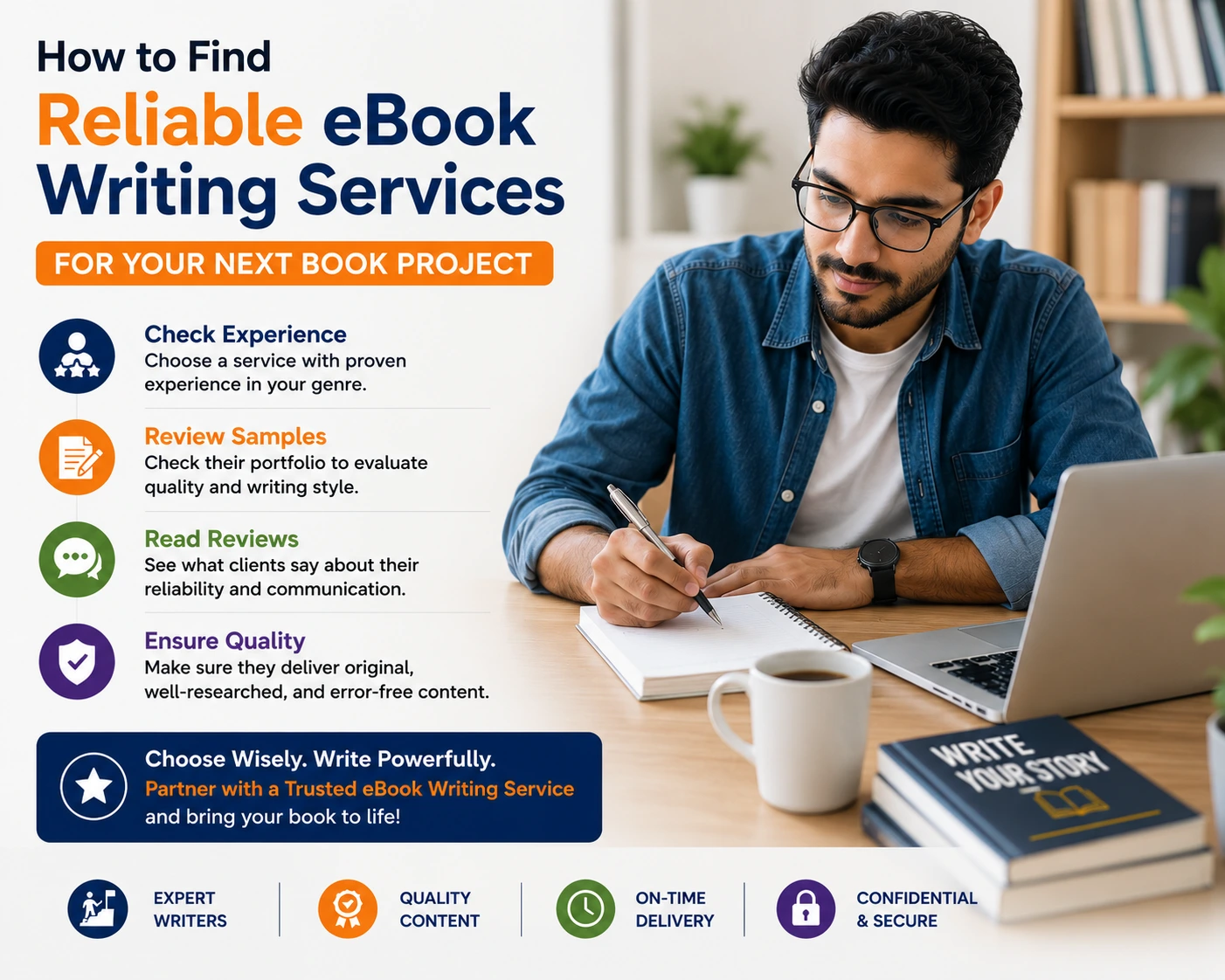
Publishing an eBook today involves more than just writing a book — it's about creating a profit-generating asset in a multibillion-dollar industry.
The global eBook market is expected to hit $15.33 billion by 2027, with a 4.9% CAGR — but this growth doesn't benefit everyone equally. As the market grows, so do reader expectations. Books that appear or read like amateur efforts are often overlooked, ignored, or returned. Quality has emerged as the key competitive differentiator.
The mindset shift is crucial. Authors viewing their eBook as a one-time creative endeavor often fall short compared to those who see it as a publishing asset — crafted with strategy, professional standards, and long-term discoverability in mind. This involves investing in the complete production process: writing, editing, cover design, metadata, and formatting.
The hidden costs of a DIY approach add up quickly. Poor metadata can harm search visibility on retail platforms before a reader even clicks. Inconsistent formatting leads to poor reading experiences, resulting in negative reviews. These aren't minor issues — they're conversion killers that no marketing budget can fully rectify later.
Professional book publishing services exist to bridge this gap, handling the technical and creative layers that determine whether an eBook sells. Understanding why they outperform the DIY route begins with how search engines and readers assess credibility — which is where the true competitive advantage lies.
The $100,000 Question: Revenue Realities for Independent Authors
Achieving six figures as an independent author is possible — but the financial realities are harsher than many aspiring writers expect.
The economics of eBook publishing are stark: royalty rates, pricing, and discoverability determine whether your book provides a living wage or just gathers digital dust.
Consider the figures. A self-published eBook priced at $9.99 on a major retail platform earns about 70% royalties — around $7 per sale. To make $100,000 annually at that rate, an author must sell roughly 14,286 copies. Lower the price to $2.99, where many debut authors compete, and you're looking at just over $2 per sale — requiring approximately 47,000 units to reach the same goal.
| eBook Price | Royalty (~70%) | Units Needed for $100K |
|---|---|---|
| $2.99 | ~$2.09 | ~47,847 |
| $4.99 | ~$3.49 | ~28,653 |
| $9.99 | ~$6.99 | ~14,306 |
Compare this to a $20 print book, where author margins after printing and distribution fees often fall below 30% — sometimes as low as $2–$4 per unit — and the eBook royalty structure appears more attractive, provided meaningful sales volume is achieved.
That volume question is where self-publishing services prove their worth beyond manuscript production. As publishing industry expert Jane Friedman notes, "The difference between a book that sells and one that sits on a digital shelf is the professional metadata and category optimization provided by a full-service publisher." Selecting the right BISAC category, writing a keyword-rich book description, and positioning a title in a subcategory where it can rank — these decisions directly affect how many readers find your book initially.
Metadata isn't marketing fluff — it's the infrastructure enabling all other promotion. A well-written book buried in the wrong category, with a generic description and no keyword strategy, will underperform compared to a mediocre book that has been professionally optimized. Understanding how distribution decisions impact visibility is often a missing piece that authors overlook entirely when projecting revenue.
The revenue math only works when discoverability works — which raises a timely question about the tools authors increasingly use to speed up production.
Balancing Speed and Quality: Can You Write an eBook Fast With AI?
AI can speed up eBook drafting — but speed without professional oversight is one of the quickest paths to a failed launch.
AI drafting tools boost productivity but don't create finished products. In practice, authors relying solely on AI for manuscripts often face issues like generic prose, factual inaccuracies, repetitive sentence structures, and a voice that reads as distinctly machine-generated. These aren't mere cosmetic flaws. Amazon's quality filters are skilled at identifying low-quality AI content, and readers are even less forgiving. According to a Reedsy analysis, readers are 50% more likely to leave a negative review due to typos than due to a poor plot — and AI-generated manuscripts often exhibit these issues.
Here, professional ghostwriting services make a significant difference. A skilled ghostwriter doesn't just clean up AI output — they restore the nuance, authority, and narrative judgment that algorithms can't replicate. They fact-check claims, restructure arguments for clarity, and adjust tone to match both the target audience and the genre's reader expectations. The result is a manuscript that reads as credibly human because, in the most important ways, it is.
The most effective approach uses AI as an initial draft scaffold and professional expertise as the essential finishing layer. Authors investing in that human oversight — rather than skipping it to save time or money — consistently produce books that withstand reader scrutiny. Understanding what that professional layer truly entails is what the next section delves into.
What to Look for in a Reliable Book Publishing Company
Choosing the right book publishing company is one of the highest-impact decisions an author can make — and the wrong choice can doom a manuscript before it even reaches readers.
- Full-service, manuscript-to-market capability. The most reliable partners manage every phase — drafting, editing, cover design, formatting, and distribution — under one roof. Fragmented services lead to handoff errors and accountability gaps. Seek a provider that can transform a raw idea into a live, optimized listing without requiring you to manage multiple vendors.
- Genre expertise and US market knowledge.A ghostwriting team familiar with category conventions, reader expectations, and platform algorithms writes to sell, not just to fill pages. Evaluating a provider's track record across genres is a practical first step before committing to any contract.
- Transparent ISBN assignment. You should own your ISBN outright. Any provider registering the ISBN under their own imprint is effectively claiming a stake in your publishing rights — a red flag worth avoiding.
- Cover design ownership. Final design files should belong to the author. Confirm this in writing before work begins.
- Marketing rights and metadata control. Reliable services handle technical details including keyword optimization for Answer Engine Optimization (AEO) and category placement — but those assets should remain yours. A strong book promotion strategy built on data you control compounds over time.
The right partner transfers ownership at every stage, not just at delivery. Once you know what to demand from a publishing partner, the path to a successful launch — and sustainable revenue — becomes significantly clearer.
The Bottom Line: Your Roadmap to Publication
Most eBooks fail for predictable, preventable reasons — and the clearest path forward is pairing professional expertise with smart strategy at every stage of the publishing process.
- Investing in professional editing is non-negotiable.Readers leave reviews based on their experience with your prose, structure, and clarity. A single wave of negative feedback about grammar or incoherent chapters can permanently damage your title's discoverability. Polished manuscript editing services protect your long-term signals and position your book for consistent, compounding sales — not a one-week spike followed by a slow fade.
- Use AI for speed, not authority. AI tools shorten drafting timelines, but human ghostwriters bring narrative judgment, genre fluency, and the type of voice consistency that earns reader loyalty across a series.
- Metadata and category placement are revenue levers. Ranking in a precise sub-category with optimized keywords often makes the difference between obscurity and reaching significant income milestones.
- Full-service partnerships outperform piecemeal hiring. A single partner managing editing, formatting, and positioning eliminates costly handoff errors between freelancers.
As Monarch Books Co puts it, "Professional book publishing services are the bridge between a hobbyist and a professional author." That perspective matters. Treating your eBook as a business asset — not a side project — changes every decision you make, from hiring fiction writers to choosing your launch window.
The right publishing partner doesn't just polish your manuscript; they architect the entire path to market. That's exactly what the next section addresses.
Transforming Your Manuscript with Monarch Books Co
The clearest path from a raw idea to a shelf-worthy eBook is partnering with someone who understands both the craft and the market. Monarch Books Co specializes in combining affordable self-publishing with high-end professional ghostwriting — allowing authors to choose both quality and budget. This combination is rare, and for US-based authors navigating a crowded digital marketplace, it's genuinely decisive.
Being US-focused is more important than many authors realize. Market-specific editing, culturally attuned voice, and strategic book marketing built for American readers all require an understanding of how US audiences discover, evaluate, and buy books. A generic publishing service can produce a technically competent manuscript — but competent rarely converts. What sells is a book that feels native to its market, positioned correctly from the start.
The next step is straightforward. A manuscript evaluation identifies where your project stands — structurally, stylistically, and commercially. From there, the right mix of ghostwriting, editing, and marketing support is tailored to your specific goals. Whether you're starting with a concept or have a draft that never quite landed, the process is designed to meet you where you are.
Your book doesn't have to be another eBook failure statistic. Reach out to Monarch Books Co today to schedule a publishing consultation and discover what your manuscript needs to reach real readers.
frequently  asked questions
What is the eBook market worth in 2026?
The global eBook market is expected to reach $15.33 billion by 2026, growing at 4.9% CAGR.How many copies do I need to sell to make $100K?
At $9.99, you need ~14,286 sales. At $2.99, that jumps to ~47,847 sales.Can AI write my eBook?
AI helps with drafting, but a professional ghostwriter is essential for voice, tone, and accuracy.What should I look for in a publishing company?
Full-service capability, ISBN ownership, cover design rights, and metadata control — all yours to keep.Why does metadata matter?
Wrong metadata buries your book before readers even find it. Right keywords and category placement drive real sales.


