
Christian and Faith-Based Book Publishing Guide (Everything You Need Before You Publish)
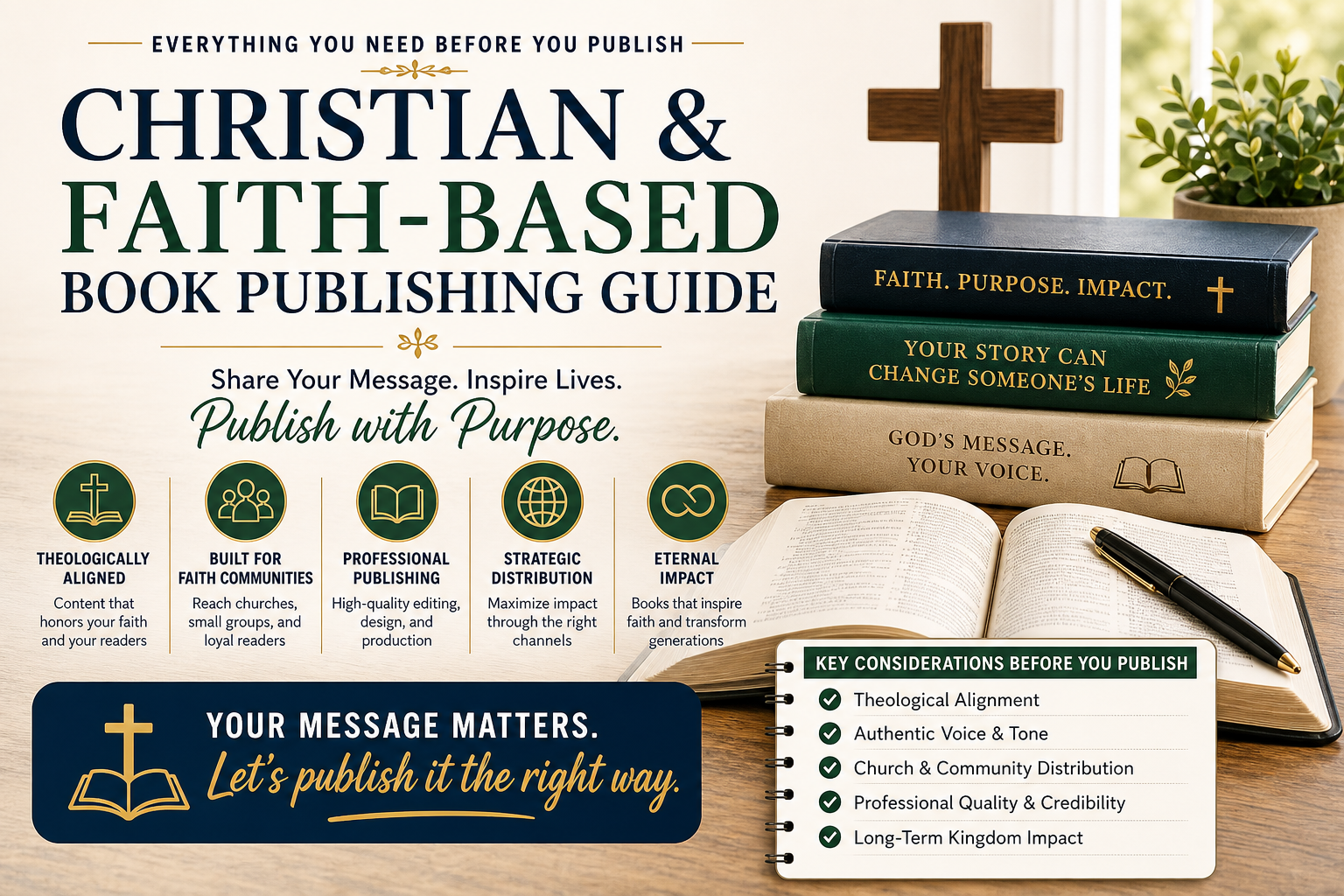
You didn't write this book for fame. You wrote it because something happened: a transformation, a revelation, a season of suffering that became a season of growth, and you know someone else needs to hear it.
That calling is real. And it deserves more than a rushed publishing decision.
The faith-based publishing marketis one of the most passionate, loyal, and community-driven reader audiences in the world. Christian readers don't just buy books, they recommend them from pulpits, pass them through small groups, and return to them for decades. A well-published faith-based book doesn't just sell. It ministers.
But getting there requires understanding a publishing landscape that has unique rules, unique readers, and unique opportunities that general book publishing services guides completely overlook. This is the guide that fills that gap.
Understanding the Faith-Based Publishing Landscape
The Three Tiers of Christian Publishing
Tier 1: Traditional Christian Publishers. Houses like Thomas Nelson, Zondervan, and Tyndale. Highly selective, advance-paying, long timelines. Require literary agents. Best for authors with existing platforms of 10,000+ followers.
Tier 2: Hybrid and Independent Christian Publishers. Author-invested, professionally produced, faith-aligned editorial standards. The fastest-growing segment of Christian publishing. Best for authors with a message, a community, and readiness to invest in quality.
Tier 3: Self-Publishing with Faith-Specific Support. Platforms and agencies that understand Christian content standards and distribution. Best for authors wanting full control with professional guidance.
Most first-time and mid-career Christian authors belong in Tier 2 or Tier 3, and that's exactly where the most important publishing decisions get made.
What Makes Faith-Based Publishing Different
1. Theological Alignment Is Non-Negotiable
This is the dimension that separates Christian publishing from every other category, and it's the one most general publishers miss entirely.
Your publishing partner needs to understand and respect your theological framework. Denominational distinctions matter to your readers. A Reformed reader has different expectations than a charismatic one. A Baptist reader approaches content differently than a Pentecostal one.
A ghostwriting agency that treats all Christian content as interchangeable doesn't understand your audience, and an audience that feels misrepresented won't buy, and won't recommend.
Before signing with any publisher, ask:
- What is your editorial stance on theological content?
- Have you published books in my specific denominational tradition?
- Who reviews content for theological accuracy?
2. The Language of Faith Has Its Own Register
Christian readers are sophisticated. They recognize authentic voice immediately, and performative faith language just as fast.
A professional ghostwriting service partner with faith-based experience understands this tonal balance: the difference between writing that sounds Christian and writing that actually ministers to a Christian reader. Your book needs genuine voice, not rehearsed testimony language or overused spiritual clichés that have lost all meaning.
3. Your Distribution Strategy Must Include Church Channels
This is the insight most general publishing guides completely miss, and it represents enormous untapped opportunity.
Church distribution channels include:
- Church bookstores and resource centers — many mid-to-large churches maintain physical book inventories
- Small group curriculum adoption — a book that becomes small group material sells in bulk, repeatedly
- Pastoral recommendation — a single endorsement from a respected pastor can move hundreds of copies
- Conference and retreat sales — speaking at Christian events creates captive, motivated buyers
- Christian radio and podcast placement — faith-based media audiences buy books at exceptionally high rates
A book publishing agency that understands faith-based distribution will help you map these channels before launch, not after you've already missed the opportunity.
The Content Categories That Sell in Christian Publishing
| Category | Market Demand | Notes |
|---|---|---|
| Personal testimony / memoir | Very High | Authentic transformation stories drive word-of-mouth |
| Devotionals | High | Daily format creates habitual reading and gifting |
| Biblical study / commentary | High | Strong church and small group adoption potential |
| Christian parenting | High | Perennial category with strong community sharing |
| Christian fiction | High | Romance and historical fiction lead the category |
| Spiritual warfare | Medium-High | Passionate niche with dedicated readership |
| Denominational theology | Medium | Smaller but deeply loyal readership |
Know your category before you publish. Positioning your book correctly affects everything from distribution to discoverability to the endorsements you can realistically pursue.
How to Get Endorsements: The Faith-Based Advantage
Endorsements in Christian publishing carry weight that endorsements in general publishing simply can't match. A foreword or back-cover endorsement from a respected pastor or Christian leader can transform a book's credibility overnight.
How to pursue endorsements strategically:
- Start in your own network — who in your church or denomination has credibility with your target reader?
- Work outward from there — endorsers your endorsers know are more reachable than cold celebrity pastor outreach
- Send early — endorsers need 6–8 weeks minimum; build this into your production timeline
- Provide a one-page summary — make it easy for a busy pastor to say yes
- Ask specifically— "Would you write a 2–3 sentence endorsement?" gets more responses than a vague ask
A ghostwriting company with faith-based experience will help you craft endorsement request materials as part of the pre-launch process, because how you ask matters as much as who you ask.
Choosing the Right Publishing Partner
Here's the decision framework for Christian authors evaluating publishing partners:
What to Look For
- Faith-aligned editorial team — people who share or deeply respect your theological framework
- Christian distribution relationships — CBA retailers, church channels, faith-based wholesalers
- Genre-specific design experience — a portfolio of Christian titles that look competitive in the category
- Endorsement strategy — built into the process, not left to the author alone
- Post-launch ministry support — helping you leverage speaking, small groups, and church relationships
What to Avoid
- Publishers who treat Christian content as a subcategory of general self-help
- A ghostwriting agency or book publishing company with no faith-based portfolio
- Partners who can't articulate the difference between CBA and general retail distribution
- Anyone promising mainstream bestseller lists without a credible strategy for how
Why Monarch Books Co Is Built for This
At Monarch Books Co, faith-based publishing isn't a side service, it's a core competency.
The team understands that a Christian author's goals aren't just commercial. They're ministerial.Every production decision, from editorial review to cover design to distribution strategy, is made with one question in mind: does this serve the author's calling and their reader's faith journey?
Monarch Books Co brings together faith-aligned editors, designers with Christian market experience, and distribution relationships that reach beyond Amazon into the church and CBA retail channels where faith-based books actually move.
Your Faith-Based Publishing Checklist
- Publisher has faith-based titles in your specific category
- Editorial team understands your theological framework
- Distribution includes CBA and church channels
- Cover design portfolio includes competitive Christian titles
- Endorsement and pastoral outreach strategy is included
- Post-launch support covers community and speaking channels
- You retain full rights to your manuscript
Your message found you for a reason.Now let's make sure it finds the people who need it.
frequently  asked questions
Do I need a literary agent to publish a Christian book?
Only if you're targeting major traditional houses like Zondervan or Tyndale; most require agent representation. For hybrid publishing, independent Christian publishers, and full-service self-publishing routes, agents are not required. Many successful faith-based authors publish without agents by working with experienced publishing partners who provide strategic guidance an agent would otherwise offer.Can I publish a faith-based book if I'm not an ordained minister?
Absolutely. The Christian publishing market includes authors from every background: laypeople, missionaries, counselors, parents, and survivors whose faith shaped their recovery. What matters to Christian readers is authentic testimony and genuine biblical grounding, not a title or credential. Your lived experience is what creates connection with your reader.How do I get my book into Christian bookstores?
Christian bookstores source inventory through faith-based distributors like STL Distribution and Anchor Distributors. Getting your book into these systems requires working with a publisher that has existing relationships with them. This is one of the most important questions to ask any publishing partner before signing because most general self-publishing platforms have no CBA distribution relationships at all.Should a faith-based book be marketed differently than a general book?
Yes, significantly. Faith-based marketing works through community trust networks, not just algorithmic discovery. Pastoral endorsements, small group adoption, church speaking, Christian radio, and faith-based podcast placements are all high-leverage channels that general marketing strategies ignore entirely. The most effective faith-based launches combine Amazon visibility with deep community marketing simultaneously.What if my book addresses controversial topics within Christianity?
Controversial content in Christian publishing requires careful positioning, not avoidance. Some of the most impactful Christian books have addressed addiction, abuse, doubt, and deconstruction. The key is theological grounding and pastoral sensitivity in how content is framed. Work with a publishing partner experienced in navigating controversial faith-based content because how you frame it determines whether it ministers or alienates.


