
AI in Publishing Industry: Benefits and Challenges for Authors and Publishers (2026 Guide)
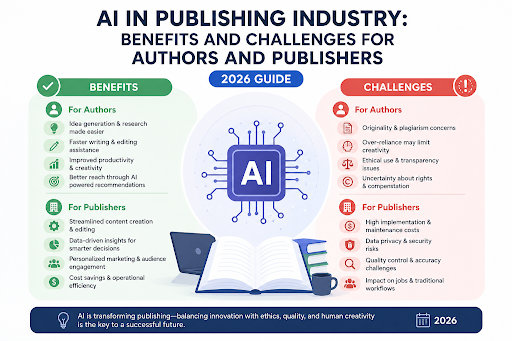
If you're weighing whether to publish my book with AI tools in the workflow, or trying to decide which book publishing company actually knows how to use AI responsibly, you're asking the right question at the right time. 2026 is the year AI stopped being a novelty in publishing and became a line item — in budgets, in KDP's upload form, and in the contracts authors sign with book publishing services.
This isn't another "AI will change everything" think piece. It's a working breakdown of exactly where AI helps, where it creates real legal and reputational risk, and how to make decisions about self publishing services, professional book publishing, and affordable book publishing services without getting burned by either blind adoption or blind avoidance.
We'll also cover what most industry coverage of this topic skips entirely: Amazon's actual AI disclosure enforcement mechanics, how to vet a publisher's AI practices before you sign, the real cost math of AI-assisted production, and where the copyright litigation currently stands.
Where AI Actually Sits in the Book Publishing Workflow Right Now
Digital publishing isn't a side channel anymore — it's the growth engine. Industry market research pegs the global digital publishing market at roughly $56.5 billion in 2026, on a path toward $87 billion by 2030. That expansion is exactly why AI adoption is accelerating: digital-first, retailer-mediated publishing is a data-and-speed game, and AI is the tool that lets small teams compete on both.
But adoption is uneven, and that unevenness is the story most people miss. Recent industry survey data from the Book Industry Study Group found that AI use clusters heavily around low-risk, operational tasks — marketing copy, administrative work, and data analysis — while high-stakes areas like rights and licensing management and QA testing see almost no AI use at all. Fewer than one in ten publishing professionals report using AI for audiobook narration or licensing decisions.
The takeaway for authors: AI is trusted with volume and speed. It is not yet trusted with judgment. That distinction should guide every decision you make about where AI belongs in your own publishing process.
AI Benefits for Independent Authors Using Self Publishing Services
If you're going the indie route, AI functions as a part-time staff of specialists you can't otherwise afford. Here's where it earns its keep:
1. Manuscript Editing and Line-Level Proofreading
AI editing tools catch grammar errors, inconsistent tense, repetitive phrasing, and pacing issues far faster than a first human pass. What they don't reliably catch: structural storytelling problems, tonal authenticity, and cultural nuance. Treat AI editing as triage — it clears the mechanical clutter so a human developmental editor can focus on the parts of your manuscript that actually determine whether readers finish the book.
2. Metadata, Keywords, and Category Selection
This is arguably the highest-ROI use of AI in how to publish a book successfully on Amazon. Instead of guessing at the seven KDP keyword fields or picking BISAC categories by instinct, AI tools can cross-reference genre-specific search behavior and competitor listings to suggest metadata that's actually discoverable. Discoverability, not writing quality alone, is what determines whether a well-written book ever finds its readers.
3. Cover Design at Indie Budgets
AI-assisted cover generation gives authors who can't afford a $600–$1,500 professional designer a way to test genre-appropriate concepts fast. The honest caveat: AI covers still tend to look slightly generic up close, and readers in competitive genres (romance, thriller) can often spot them. Use AI to prototype directions, then have a human designer refine the winning concept — you get 80% of the cost savings with none of the "this looks AI-made" risk.
4. Marketing Copy and Launch Assets
Book blurbs, ad copy variants, newsletter sequences, and social captions are exactly the kind of high-volume, low-risk-per-unit content AI handles well. Generate ten blurb variants, A/B test them, keep what converts.
5. Market and Trend Analysis
AI tools can process reader review sentiment, competitive comps, and genre trend data far faster than manual research — useful when deciding your next title, series direction, or pricing strategy.
Bottom line for indie authors: AI doesn't replace the services a book publishing company provides — it changes which of those services you still need to pay a human for. Editing judgment, cover art finishing, and marketing strategy still benefit from professional oversight even when AI does the first pass.
AI Benefits for a Book Publishing Company and Professional Book Publishing Operations
For publishers and full-service houses, AI's value shows up at the operational layer, not the creative one.
- Production throughput: Manuscript intake, formatting checks, and pre-editorial QA can be partially automated, shortening the runway from signed manuscript to market.
- Metadata and discoverability at scale: A publisher managing hundreds of titles benefits enormously from AI-driven keyword and category audits across a backlist — something that would take a human team weeks to do manually.
- Rights and licensing tracking: Still the least-automated part of the industry, and for good reason — this is where mistakes are expensive. AI can flag anomalies and deadlines, but licensing decisions themselves remain a human function.
- Reader analytics and acquisition decisions: Publishers increasingly use AI-assisted analysis of sales data and reader trends to inform which manuscripts to acquire — a genuinely new capability compared to five years ago.
- Smaller publishers competing with the Big Five: AI narrows the operational gap between a boutique professional book publishing house and a major imprint, because tasks that used to require large specialized teams can now be handled by a lean team plus AI tooling.
If you're evaluating book publishing services, ask directly how they use AI in production. A publisher that's transparent about where AI touches your manuscript — and where a human takes over — is a stronger signal of professionalism than one that avoids the topic entirely.
AI in Audiobook Production: Faster, Cheaper, Not Yet Equivalent
Audiobooks are one of digital publishing's fastest-growing formats, and AI narration tools (including Amazon's own beta narration features inside KDP) now let authors produce audio editions without booking a professional voice actor.
The tradeoff is real. Independent analysis comparing AI voice synthesis platforms built specifically for audiobook services concluded that while synthetic narration is faster and dramatically cheaper, it still falls short of human narrators on emotional range and authenticity — the qualities that drive repeat listenership and strong reviews in a format where the performance is part of the product.
There's also an unresolved ethics layer: voice cloning without consent has already triggered public disputes in the industry. Platforms that require explicit narrator opt-in are the safer standard to hold your own production to, regardless of what a vendor's default settings allow.
Practical guidance: Use AI narration for backlist titles, low-budget test releases, or nonfiction where performance matters less. Reserve human narration for lead titles, fiction with heavy dialogue, and anything where audiobook sales are a primary revenue channel.
The Amazon KDP AI Disclosure Rules Almost Nobody Explains Clearly
This is the part of the AI conversation that directly affects whether your book stays on sale — and it's the part most industry articles gloss over. If you're planning to publish my book on KDP with any AI involvement, here's exactly how the policy works in 2026:
AI-generated content must be disclosed. AI-assisted content does not.
- AI-generated = an AI tool produced the actual text, cover art, or translation from your prompts — even if you edited it afterward. This must be disclosed during the KDP publishing workflow.
- AI-assisted = you wrote the content yourself and used AI only to brainstorm, outline, check grammar, or refine your own draft. No disclosure required.
The disclosure itself is internal to Amazon — it doesn't appear on your product page, and Amazon has stated it does not directly affect search ranking or royalties. But non-disclosure is a terms-of-service violation, and enforcement has tightened noticeably through 2025 and into 2026. Amazon now combines automated detection (writing-pattern analysis, metadata signals, submission velocity) with human review to catch undisclosed AI content.
Consequences for getting caught include:
- Book removal from sale without prior warning
- Withheld royalties on the removed title
- Account warnings or, for repeat/egregious cases, account suspension
- Extended "In Review" holds on future submissions
The riskiest pattern isn't using AI — it's publishing high volumes of thin, undisclosed AI content quickly. Amazon's stated 2026 direction is stricter quality standards paired with better detection, meaning "humanizing" tools to evade disclosure are a losing strategy, not a workaround. If in doubt, disclose. It costs you nothing measurable and removes your single biggest compliance risk.
Copyright and Licensing: Where the Real Uncertainty Lives
The unresolved legal questions around AI training data and content ownership are the single biggest reason large segments of the publishing industry remain cautious. Multiple ongoing lawsuits — including author and publisher actions against major AI developers over the use of copyrighted books in training data — haven't fully settled how compensation, licensing, and fair use apply to books specifically. Until that legal landscape stabilizes, publishers and authors are right to be careful about:
- Which AI tools were trained on legitimately licensed data versus scraped content
- Whether AI-generated cover art or illustration risks infringing on existing copyrighted styles or works
- How AI-powered "ask this book" and summarization features on retail platforms use your published content without separate consent
- Translation rights, where AI-assisted translation now overlaps with contractual foreign-rights agreements
Practical rule:Any professional book publishing contract you sign in 2026 should specify who owns AI-assisted output, whether the publisher discloses AI use per platform requirements, and how licensing/translation rights account for AI tools. If a contract is silent on AI, that's a red flag, not a neutral default.
Choosing Between Traditional, Self, and Hybrid Publishing in the AI Era
AI changes the cost-benefit math of each publishing path. Here's the honest comparison:
| Factor | Traditional Publishing | Self Publishing Services | Hybrid / Assisted Publishing |
|---|---|---|---|
| Upfront cost to author | Low (advance-funded) | Author-funded, AI lowers costs further | Mid-range, shared cost model |
| Speed to market | Slow (12–24 months) | Fast, AI compresses this further | Moderate |
| Editorial control | Publisher-led | Full author control | Shared |
| AI risk exposure | Managed by publisher | Author is fully responsible for disclosure/compliance | Publisher typically manages compliance |
| Best for | Established authors, big-genre fiction | Authors wanting speed, control, and lower cost | Authors wanting professional polish without giving up rights |
If cost is your main constraint, affordable book publishing services built around AI-assisted editing and formatting can meaningfully lower your break-even point compared to a fully traditional editorial and design team — without requiring you to sacrifice quality, as long as human review still touches the final manuscript, cover, and metadata before launch.
How to Vet a Book Publishing Company's AI Practices Before You Sign
Most guides tell you AI is useful and stop there. Before committing to any book publishing services provider, ask these five questions:
- Where exactly does AI touch my manuscript?Editing pass only, cover concepting, metadata, marketing copy — get specifics, not a vague "we use modern tools."
- Who reviews AI output before it reaches me?A named human editor, not "our system."
- How do you handle KDP/retailer AI disclosure on my behalf?If they're publishing under your name, you need to know they're compliant.
- What happens to my manuscript data? Ask whether your unpublished manuscript is used to train any third-party AI model — this should be contractually excluded.
- Can I see a before/after example of AI-assisted vs. fully human work? A publisher confident in their process will show you.
A publishing partner that answers these clearly, rather than deflecting, is the one worth trusting with professional book publishing work.
What This Means for Ghostwriting, Children's Books, and Memoir Work
A few specific segments deserve their own note, since general "AI in publishing" coverage tends to flatten them into one conversation:
Ghostwriting services: AI can accelerate research and structural outlining, but a ghostwriter's core value — capturing a specific person's voice, story logic, and lived experience — is precisely the part AI can't do without heavy human involvement. Any ghostwriting engagement that leans too far on AI-generated drafting risks producing a memoir or business book that reads generically, which defeats the entire point of hiring a ghostwriter.
Children's book publishing:Illustration is the highest-risk area here. AI-generated children's illustrations face the same copyright-style ambiguity as adult cover art, plus added scrutiny from parents and educators around originality and quality. Human illustrators remain the safer default for anything beyond early concept sketches.
Memoir and nonfiction: AI is genuinely useful for organizing timelines, fact-checking dates, and tightening structure — tasks where accuracy matters more than voice. Keep AI out of the emotional core of the narrative itself.
Challenges the Industry Still Hasn't Solved
Beyond disclosure and copyright, three structural challenges are shaping how cautiously the industry moves:
- Content homogenization: AI models trained on similar data tend to produce similar sentence rhythms and plot structures. Overreliance risks a market flooded with books that read alike — a real threat to discoverability in already-crowded genres like romance and thriller.
- Reader trust and disclosure fatigue:As AI-assisted books become common, readers increasingly want to know what they're buying. Transparent disclosure, even where not legally required, is becoming a trust signal rather than a liability.
- Quality control at scale: The BISG survey data makes this explicit: publishing professionals are comfortable using AI for marketing and admin work, but stay far more cautious about editorial and rights decisions — because errors there are expensive and hard to reverse.
None of this means avoid AI. It means treat AI as a production accelerant, not a decision-maker, in every part of the process that affects reader trust or legal exposure.
How Monarch Books Co Approaches AI in Publishing
At Monarch Books Co, AI is used exactly where the data above says it earns its place — metadata optimization, first-pass editing support, and production speed — while every manuscript, cover concept, and rights decision still goes through a human editor before it reaches a reader. If you're comparing book publishing services and want a team that will tell you plainly where AI is and isn't being used on your book, that's the conversation worth having before you sign anything.
Browse more publishing insights on the Monarch Books for deeper guides on how to publish a book the right way in 2026.
Conclusion: Use AI as Infrastructure, Not a Shortcut
AI in publishing industry adoption isn't a question of if anymore — it's a question of where. The authors and publishers pulling ahead in 2026 aren't the ones using AI for everything or avoiding it entirely. They're the ones using it precisely where the data says it works — metadata, first-pass editing, marketing production, operational speed — while keeping human judgment on the decisions that actually determine whether a book succeeds: structural editing, cover finishing, licensing, and voice.
If you're ready to move forward with professional book publishing that uses AI transparently and responsibly, start with Monarch Books — or explore more publishing strategy breakdowns on the Monarch Books Co blog before you decide which path fits your book.
frequently  asked questions
Does using AI to write my book mean I can't publish it on Amazon?
No. Amazon allows AI-generated content on KDP, but you must disclose it during the upload workflow. AI-assisted content (where you wrote the book and AI only helped edit or brainstorm) doesn't require disclosure at all.Will AI replace editors, cover designers, or ghostwriters?
Not in the near term. AI speeds up mechanical and repetitive tasks — grammar checks, keyword research, first-pass concepting — but judgment-heavy work like structural editing, voice-matching in ghostwriting, and final design polish still benefits from human expertise.Is it cheaper to use AI-assisted self publishing services than a traditional book publishing company?
Generally yes for upfront cost, especially for editing, formatting, and marketing copy. But cost savings only hold if a human still reviews the AI output — unedited AI content tends to underperform and can trigger platform quality flags.Do I need to disclose AI-generated book covers on KDP?
Yes. Amazon's disclosure requirement covers AI-generated text, images (including covers), and translations — not just written content.How do I know if a book publishing company uses AI responsibly?
Ask exactly where AI touches your manuscript, who reviews the output, how they handle retailer disclosure requirements, and whether your manuscript data is protected from being used to train third-party models.What's the biggest AI-related risk for authors right now?
Undisclosed AI content on retail platforms and unresolved copyright questions around AI training data — both carry real financial and reputational consequences if ignored.


